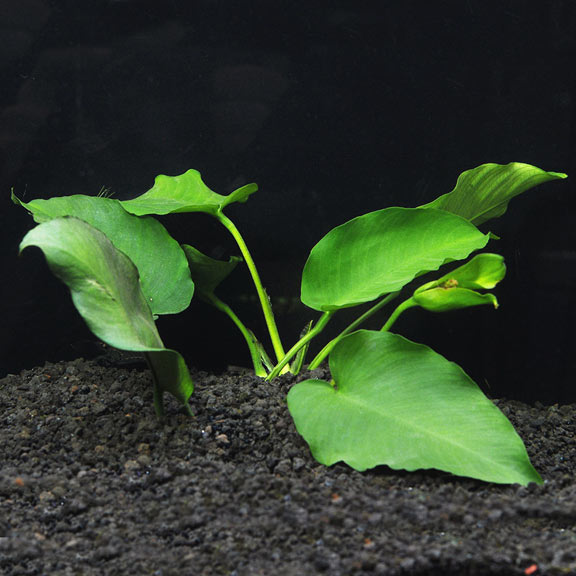
Anubias barteri
Anubias barteri, also known as Anubius or Anubias barteri, is a hardy plant that has lush green arrow shaped foliage. This rosette plant may reach up to 16 inches in width and has thick, creeping rhizomes. This variety of Anubias barteri is an amphibious form that will survive either totally or partially submersed.
Anubias prefers moderate lighting, approximately 2 to 3 watts per gallon provided by a fluorescent fixture with daylight bulbs (5000-7000°K). A pH of 6.5 to 7.5 is ideal, and is best maintained with an alkalinity of 3 to 7 dKH. When planting the aquatic plant, take special care of the rhizome and the roots. A quality substrate fertilizer is necessary, and CO2 fertilization is also recommended. In order to keep these plants small, simply trim back the leaves near the rhizome with a sharp pair of scissors.
Because it grows well from cuttings, you can usually propogate it easily. Under correct water conditions, the Anubias barteri round leaf propagates by side shoots on the rhizome, causing rhizome division. It attaches itself to rocks, driftwood, substrate, and may even float.
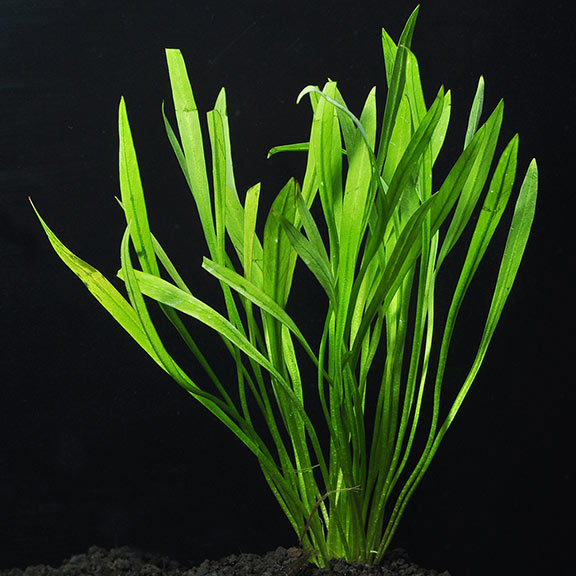
Chainsword
The Chain Sword - Narrow Leaf, also known as the Pygmy Chain Sword, is the smallest species of the Alismataceae family. It has very linear leaves, almost without petioles. The Chain Sword - Narrow Leaf requires sandy soil and plenty of light. Under the proper conditions, this Sword Plant will form a thick carpet with its numerous runners. It is amphibious, and will grow either partially or fully submersed.
The Chain Sword - Narrow Leaf requires moderate lighting and water temperatures between 68°-84°F for best growth. It prefers water that has a neutral pH, but can be housed in water with a pH of 6.2-7.5 and still flourish. A nutrient rich substrate will promote growth.
The runners that grow off of mature, healthy plants can best propagate the Chain Sword - Narrow Leaf. When the "baby" is approximately half the size of the "parent," cut the roots apart so they may grow separate from one another. They may occasionally produce seeds that can be used to cultivate new plants, and can also produce adventitious shoots to be used for propagation.
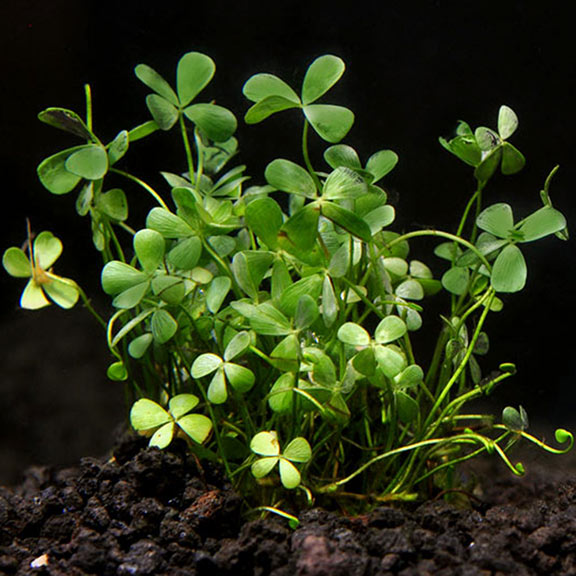
Four Leaf
The Four Leaf Clover, also known as the Clover Fern, originates from inland Australia. It has two pairs of leaflets arranged in a four leaf clover pattern. The Four Leaf Clover can grow in a number of different soil types, ranging from sands to clays. Under the proper conditions, this fern will form a thick carpet with its numerous runners. It is amphibious, and will grow either partially or fully submersed.
The Four Leaf Clover requires high light conditions and water temperatures between 68°-84°F for best growth. It prefers water that has a neutral pH, but can be housed in water with a pH of 6.2-7.5 and still flourish. A nutrient rich substrate will promote growth.
Planting the runners that grow from mature, healthy plants is the best way to propagate the Four Leaf Clover. When the "baby" is approximately half the size of the "parent," cut the roots apart so they may grow separate from one another. They may occasionally produce seeds that can be used to cultivate new plants, and can also produce adventitious shoots to be used for propagation.
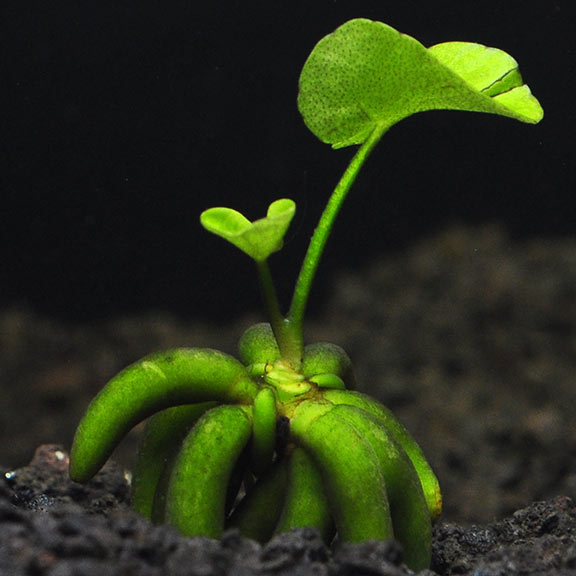
Banana Plant
Banana Plant, also known as the Big Floating Heart, is an interesting and unique looking Rosette Plant. It has banana-shaped roots that remain partially unplanted, and store the nutrients for the rest of the plant. The only member of its genus to be used as an aquarium plant because it is the hardiest, and most tolerant of deep water and low light. It is an amphibious plant and will grow either fully, or partially submerged.
The banana-shaped roots of this plant should be planted no more than 1/4 of their length. Plant them by gently pressing them into the substrate. The Banana Plant should be provided with a minimum of 2 watts per gallon of light within the spectrum of 5000 to 7000K. The ideal water conditions for best results are a temperature of 68°-82°F, an alkalinity of 3 - 6 dKH and a pH of 6.0-7.2.
Propagation occurs when adventitious plants are formed and firmly pressed into damp ground or the aquarium substrate. Fully formed leaves may also be pressed into substrate to form new plants. Use Banana Plants as foreground plants and plant them singly for best results and for the most attractive look.
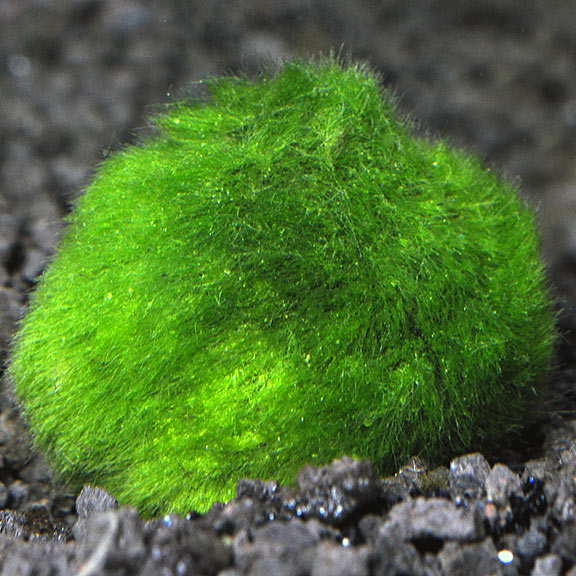
Moss Ball
The Moss Ball is a spongy velvet-like green algae ball that in the wild is found around Japan and Northern Europe. They were once thought to be extremely slow growing, but recent studies suggest that the growth can be accelerated by providing more nutrients. In its natural habitat, they are moved around by undercurrents and sink or rise in order to receive plenty of light to carry out photosynthesis.
The Moss Ball requires moderate to high lighting, approximately 3 watts per gallon provided by full spectrum (5000-7000K) bulbs. The temperature of the water should be between 72°-82°F, with an alkalinity of 3-8 dKH and a neutral pH.
The Moss Ball propagates by division. It starts with a division line which progresses to the splitting off of a smaller new Moss Ball.