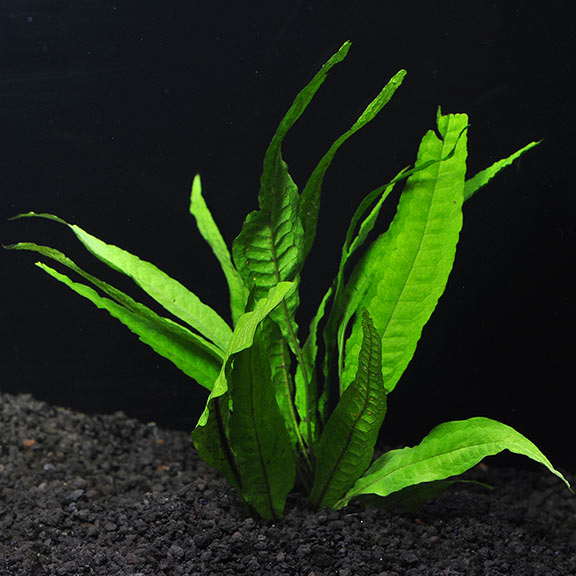
Java Fern
Java Fern is a beautiful addition to the freshwater, planted aquarium. Growing around 8 inches tall, with creeping, green rhizomes, Java Ferns are well suited for not only planted aquariums, but also those that contain cichlids and other large South American fish.
Java Ferns will do well if planted in moderate light as well as in a shaded area. It is amphibious, meaning that it will grow either partially or fully submersed. Provide at least 2 watts per gallon of light supplied by full spectrum (5000-7000K) bulbs.
Java Ferns will thrive in an aquarium with an alkalinity of 3-8 dKH and a pH of 6.0 to 7.5. They will propagate by adventitious plants on leaves & roots, and rhizome division may also be seen. Java Fern looks great planted singly, or in groups if there is enough room in the aquarium.
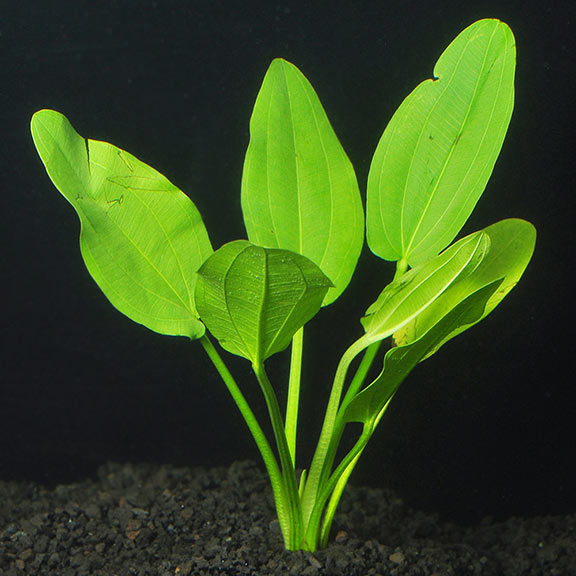
Radican Sword
The Radican Sword, also known as the Swordplant or the Creeping Burhead, is a Rosette plant that may grow to 20 inches in height. Its leaves are stemmed, and are a vibrant green in appearance. The Radican Sword may also produce long-stemmed, floating leaves. It is an amphibious plant and will grow either partially or fully submersed.
The Radican Sword should be housed in an aquarium large enough to accomodate its size. The floating leaves should be removed to prevent the shedding of submersed leaves on it, and to allow enough light to reach the other aquarium plants. For the best growth, fertilization must be provided.
The Radican Sword requires a water temperature of 72°-82°F, an alkalinity of 3-8 dKH and a pH of 6.5-7.5. For the best growth, provide at least 2 watts per gallon using full spectrum (5000-7000K) bulbs.
This plant propagates by adventitious plants on the peduncle, and occasionally, also by dropping seeds. For the most attractive landscape, plant the Radican Sword singly. They grow best in large, open aquariums.
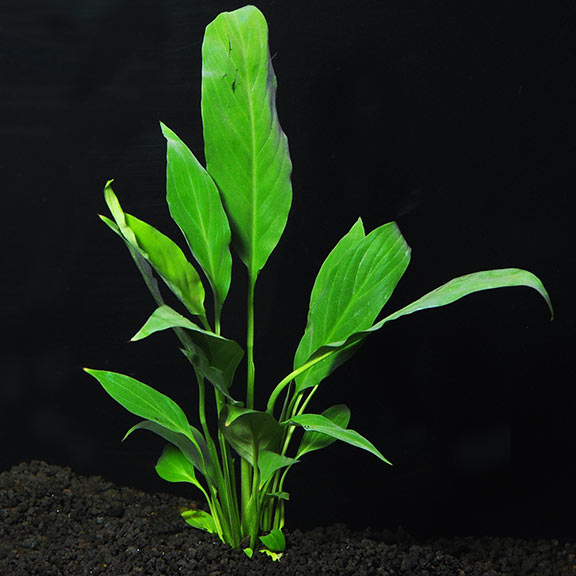
Brazilian Sword
The Brazilian Sword, also known as Peace Lily, or Madona Lily is from Tropical America. This slow growing Rosette plant can obtain heights of 16 inches. The Spathiphyllum tasson's petiole is larger than its blade, which is ornamented by well-elevated veins.
A member of the Araceae family, this plant requires water temperatures of 73°-83°F. The Brazilian Sword prefers a neutral pH, with a range of 6.5-7.0 being best. It is not a true aquatic plant but will do extremely well in your terrarium. Provide at least 3 watts per gallon of full spectrum light (5000-7000K).
This plant will add interest to any terrarium. Young plants may be obtained by cutting the rhizome. To keep this plant from overgrowing the terrarium, simply cut back the tall leaves.
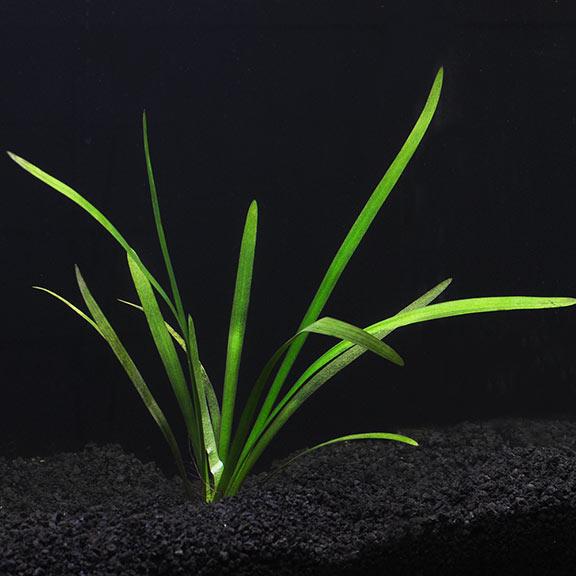
Chilensis
Sagittaria platyphylla is commonly known as Chilensis or Broad Leaf Sagittaria, and is a wide blade, grass-like plant. It is green in color, fast growing and can be placed in a variety of locations within the aquarium.
Plant the Chilensis in bunches or singly in the mid-ground part of the aquarium to provide a variance of leaf styles within the aquarium. Trim any dead tips on these plants, to inhibit the entire leaf from decaying. This plant is amphibious and will grow out of the water in a small aquarium. Provide a moderate amount of light in the range of 2 to 3 watts per gallon, using full spectrum bulbs (5000-7000K).
Reproduction with this plant occurs through runners set out by the plant, or by seed production. Allow the new plant to develop a root system and immature leaves prior to separating it from the mother plant. At that time, it can then be planted in a different location, or simply left in the same position.
The Chilensis benefits from regular additions of CO2, iron rich fertilizers, and trace elements.
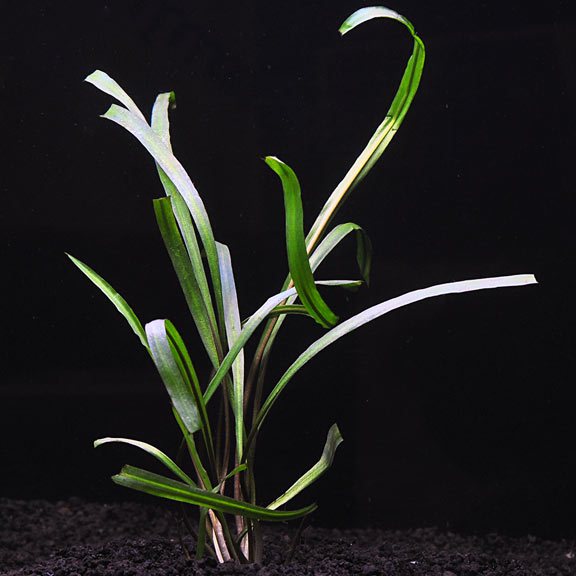
Spiralis
Spiralis, also known as Cryptocoryne spiralis, adds both height and visual drama to freshwater planted aquariums. Considered the most "primitive" of Crypocorynes and distinguished by a septum closing the kettle, Spiralis is a common plant found in India's rice fields. Tall, slender, ruffled leaves sway gracefully under water, while emergent forms grow considerably shorter with broader leaves.
Spiralis require a substrate that is fertilized with an iron-rich fertilizer. Regular pruning and thinning will keep it looking its best. Spiralis requires stable water conditions to prevent rotting of the stems and leaves. Provide at least 2 watts per gallon using full spectrum bulbs (5000-7000K). Water temperature should be between 75° and 82°F, with a dKH of 3-8 and a pH of 6.5 to 7.5.
For best results, use Spiralis as a solitary plant. They may also be planted in groups with good results. If planted in thick groups, all variations will grow taller and narrower. When planting in this fashion, place the smaller types in the foreground of the aquarium, with the larger ones in the center and back. Spiralis propagate by growing multiple runners, and can be also be propagated through rhizome division.