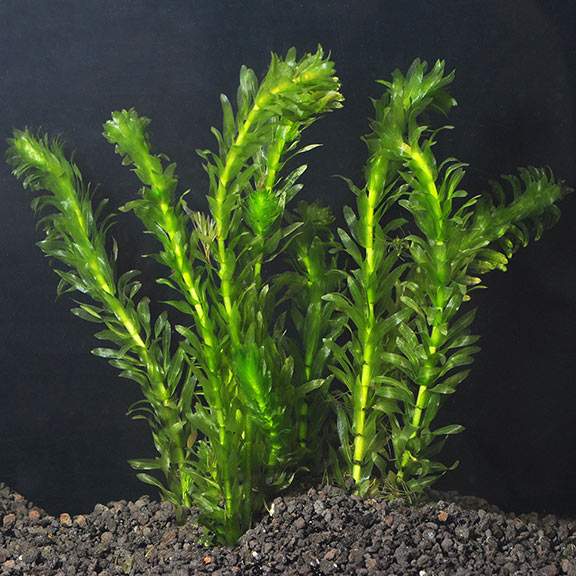
Anacharis
The Anacharis, also known as the Brazilian Waterweed, is an ideal aquatic plant for beginners. Beautiful light to bright green leaves, with branching stems covered in bunches of linear, whorled leaves. The Anacharis anchors itself in the substrate by its roots, but will also grow when floating freely.
The Anacharis can be housed in tropical or coldwater aquariums. When kept in a tropical aquarium, they require regular additions of fertilizer and a moderate amount of light. With the addition of CO2 fertilization, they will thrive in even hard water. The Anacharis is an excellent nutrient controller and oxygen producer for all types of freshwater aquariums and is also a suitable plant for use in aquariums that house livebearers or American sunfish.
Provide at least 2 watts per gallon of light provided by full spectrum (5000-7000K) bulbs, and keep the aquarium water between 59°-82°F. Anacharis plants grow the best in water with an alkalinity of 3-8 dKH with a nuetral pH of 6.5-7.5. Propagate by removing cuttings from mature, healthy plants. The Anacharis looks best when planted in groups along the back and sides of the aquarium.
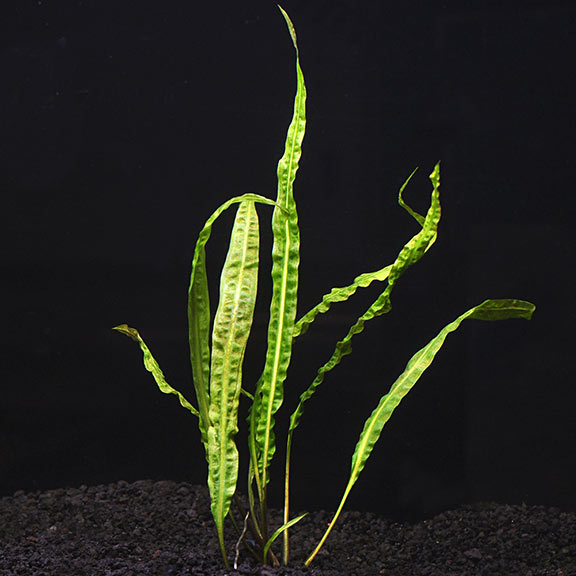
Balansae
Cryptocoryne crispatula, also known as the Balansae plant, has very long, thin leaves with ruffled edges and relatively short stems. This plant is amphibious, and when grown out of the water, the leaves will shorten, lose the ruffle, and take on a rounded appearance.
The Balansae plant requires a moderate amount of attention to maintain, but is rather flexible in the location of the aquarium where it can be incorporated. Plant the Balansae plant in the background, or sides of the aquarium, or use it as a focal point in the larger aquarium. It can also be used as a mid-ground plant in the smaller aquarium, by removing the mature leaves, in order to keep the plant short. It requires a moderate level of light of 2 to 3 watts per gallon provided by full spectrum (5000-7000K) bulbs.
Reproduction within this species is by adventitious plants, or by seed. Allow the new plant to form its own leaves prior to separating it from the mother plant, and relocating it in the aquarium.
The Balansae plant benefits from regular additions of CO2, iron rich fertilizers, and trace elements.
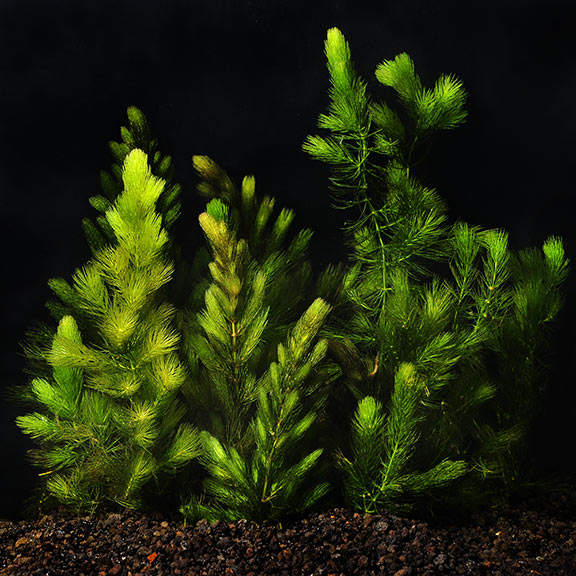
Hornwort
Hornwort, also known as Coontail, has sturdy, layered hair-like foliage that helps oxygenate and clarify the water as well as keep algae growth to a minimum. It is found free-floating worldwide, in moving and still waters, or loosely anchored in muddy bottoms.
Hornwort leaves are dark green and grow from a 1/2 to 1-1/2 inches long on stems that can reach 24 inches in length. They may be potted or just left to float in the aquarium.
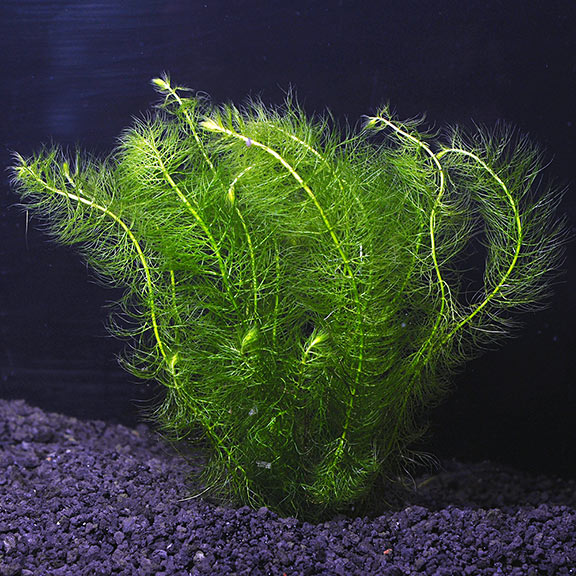
Myrio Green
Myriophyllum pinnatum is commonly known as Cutleaf Watermilfoil or Green Foxtail, and grows naturally in the lakes and streams of Southern North America, and Central America. This plant has a beautiful green coloration, and with its fine leaves is very delicate looking. These plants will grow very rapidly in the aquarium, and are amphibious, meaning they can grow partially above the water.
The Myriophyllum pinnatum is a rapidly growing plant that is ideal for planting in the background of the aquarium to hide equipment, and for providing refuge for newborn fish. Be carefull that this plant does not shade any of the other plants in the aquarium. It requires a moderate level of light of 2 to 3 watts per gallon provided by full spectrum (5000-7000K) bulbs.
Reproduction within this species is by cuttings. Simply cut the plant at the height that you desire, but leave room for growth, then strip about an inch of the stem and plant into the gravel. If allowed to grow out of the water, this plant will produce a flower.
The Myriophyllum pinnatum benefits from regular additions of CO2, iron rich fertilizers, and trace elements.
Moneywort
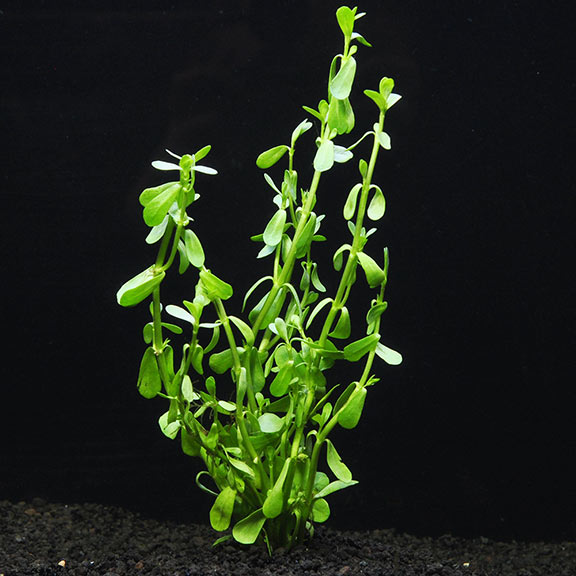
Moneywort, also known as Brahmi to herbalists, is an excellent plant for aquarists who are new to keeping live plants. The leaves are elliptic and grow alternately along the stem. They are bright green, almost lime colored when hit by the light, and make an attractive addition to any aquarium. They are amphibious and will grow either partially or fully submersed.
Moneywort is a moderately hardy stem plant that will thrive in most aquariums. It will typically grow to 12" tall, but may grow even taller under high light conditions, even continuing to grow horizontally until it reaches the water's surface. If left untrimmed, it will extend its branches out of the water.
Provide a minimum of 2 watts per gallon of full spectrum (5000°K-7000°K) lighting for the best results. Moneywort can tolerate water temperatures from 72°-82°F, but for optimum growth, the temperature should be approximately 76°F.
There are two ways to propagate the Moneywort plant. When sufficient vertical growth is observed, white roots should begin appearing at leaf nodes. When these roots are approximately one-half inch long, cut the stem 1" below the roots and insert into the substrate. The second option is to allow the Moneywort plant to grow until it has reached the surface. It will start to grow horizontally along the surface and put roots out at each leaf node. Allow these roots to grow to approximately 2" long, then cut each root section and plant in the substrate. This option is best if you wish to grow a large number of plants.